Power banks on Singapore Airlines and Scoot: current rules
You may carry up to two power banks per passenger on Singapore Airlines (SIA) or Scoot, subject to capacity and condition restrictions. They must travel in the cabin, outside overhead compartments. Neither airline allows you to use them to charge devices or recharge the banks themselves during the flight.
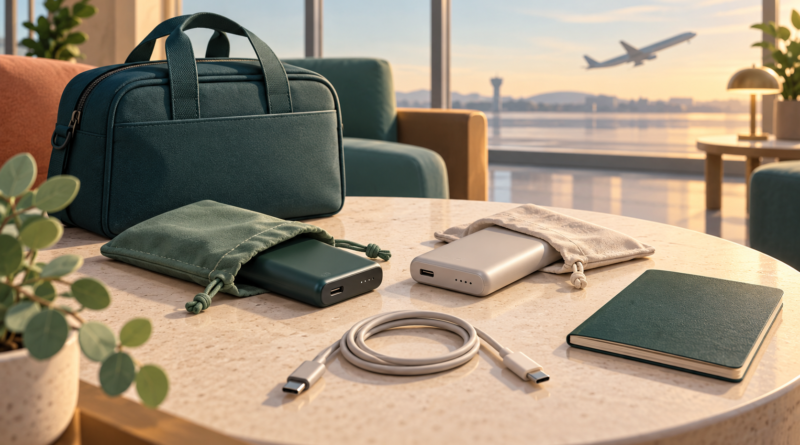
Illustration: AI-generated conceptual artwork.
Checked 2 November 2026 against official guidance. Both airlines applied the two-bank cap from 15 April 2026. This guide is based on research, without hands-on testing or trip-specific airline confirmation.
Carry, seek approval or leave behind?
Read each bank’s labelled watt-hour (Wh) rating before packing. Do not apply a universal milliamp-hour (mAh) limit or assume a voltage. Count actual power banks: a separate allowance for 20 spare batteries does not permit 20 power banks.
| Labelled capacity | Singapore Airlines | Scoot |
|---|---|---|
| Below 100Wh | Carry without prior approval | Carry without prior approval |
| Exactly 100Wh | Carry without prior approval | Obtain confirmation: published boundaries conflict |
| Over 100Wh through 160Wh | Prior approval required | Prior approval required |
| Above 160Wh | Leave behind: prohibited | Leave behind: prohibited |
Scoot’s exactly-100Wh boundary
Scoot’s power-bank advisory says up to 100Wh needs no special approval. Its baggage table instead places 100Wh in the 100–160Wh approval band, with the lower band labelled below 100Wh. Acceptance at exactly 100Wh therefore remains unresolved. Our recommendation: obtain Scoot’s confirmation before travel; if unresolved, consider a clearly below-100Wh bank. Neither this table nor a photograph guarantees permission to carry it.
Arrange approval before the airport
For SIA, a bank over 100Wh and no more than 160Wh requires an application through the form linked from its baggage restrictions page. Supply a photograph showing power and voltage ratings, plus official documentation demonstrating compliance with UN38.3, the relevant UN battery-testing requirements. Obtain that documentation from the manufacturer or retailer; marketing claims do not replace it.
Contact Scoot directly about approval for the same larger capacity band and ask how to apply and how long to allow. No specific Scoot application channel or turnaround time is established here. Arrange permission before reaching the airport, as the Civil Aviation Authority of Singapore’s packing guidance advises. If ratings or documents are unclear, resolve them with the manufacturer and airline before travel.
Pack for accessible storage
Both carriers prohibit checked-baggage carriage and overhead storage. SIA specifies accessible locations such as the seat-back pocket or under the seat ahead in its power-bank carriage advisory. We recommend keeping banks accessible on either carrier. During the flight, do not connect one to your phone or another device, or connect it to an aircraft power source to recharge.
Individually protect each bank against damage and short circuits. Use original packaging, a separate protective case, pouch or bag, or insulation over exposed terminals as appropriate. Both airlines prohibit damaged or recalled batteries; leave those behind regardless of capacity.
Final checklist
The following combines the carrier requirements above with our preparation recommendations.
- Count no more than two banks and check each labelled Wh rating.
- Obtain any required approval; resolve an exactly-100Wh Scoot bank before travel.
- Protect banks individually, keep them accessible and remove them if your cabin bag is taken for checking.
- Our recommendation: charge essential devices before boarding and keep banks disconnected throughout the flight.
- Recheck every operating airline and relevant airport for your itinerary. These two carriers’ rules do not establish worldwide clearance or acceptance for an individual journey.